
What’s Up in Rome? A $10 Million DRI, The Runway, Chobani, and a Waterfront Finding Its Footing
Rome does not always get the headline.
Utica tends to grab the spotlight. Cooperstown gets the postcard treatment. The Adirondacks loom nearby like the cool older cousin with a cabin and better hiking boots.
But in the last two years, a lot has happened in Rome.
A second $10 million Downtown Revitalization Initiative award. A major waterfront strategy. A proposed indoor recreation complex at Griffiss. And a $1.2 billion Chobani plant that will become one of the biggest food manufacturing investments in the country.
So, yes.
It is probably time to take another look at the Copper City.
Rome Receives a Second $10 Million DRI Award
In April 2026, Rome received a $10 million Downtown Revitalization Initiative award from New York State, becoming the first community in the state to receive a second DRI award.
That matters for two reasons.
First, it brings real funding into the city’s waterfront and downtown corridor. Second, it confirms that the state sees Rome’s revitalization as something worth continuing, not something that peaked with one round of investment and a few nicely designed signs.
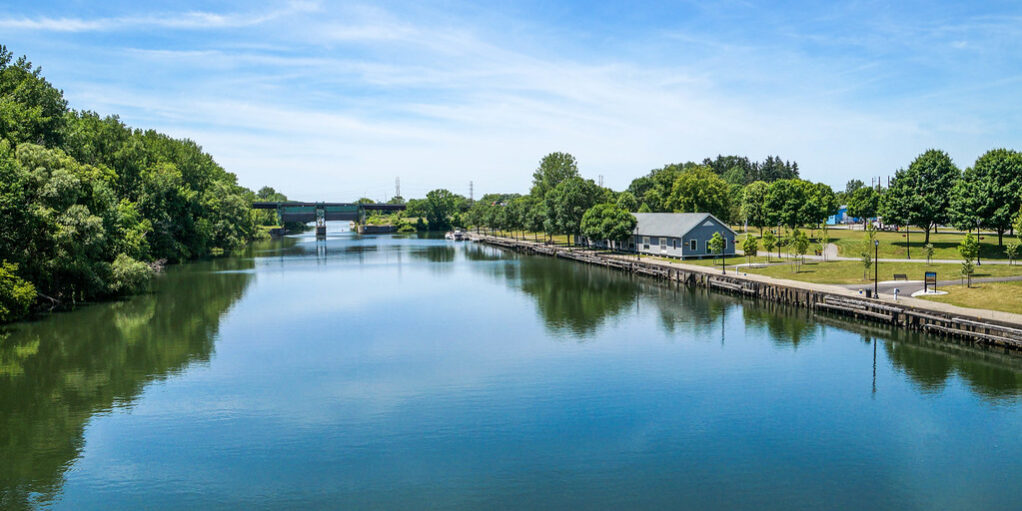
This round of DRI funding focuses on the area along Bellamy Harbor, the Mohawk River, the Erie Canal, East Dominick Street, and surrounding neighborhoods. The goal is to connect waterways, neighborhoods, industry, housing, trails, and public gathering spaces into a stronger downtown and waterfront district.
In plain English: Rome is trying to turn its waterfront into something people use every day.
Not just a backdrop.
Not just a place you remember exists when someone says, “Wait, Rome has a harbor?”
A real part of daily life.
Bellamy Harbor and the Rome Waterfront
The Rome waterfront has always had the ingredients.
Water. Trails. History. Space. Access. A connection to the Erie Canal and Mohawk River. The kind of setting that makes people say, “Why aren’t we doing more with this?”
Now, more is happening.
The DRI plan centers on two miles of canal and riverfront, including areas around Bellamy Harbor and the Mohawk River. Public trails, gathering spaces, events, housing, shops, and waterfront experiences are all part of the broader vision.
That is the right approach.
Waterfronts work best when they are built for residents first. Tourists may come, and that is great. But the strongest waterfront districts are the ones where people walk after dinner, take their kids, meet friends, catch an event, ride bikes, sit by the water, or decide to live nearby because it feels like part of the city’s rhythm.
That is what Rome has a chance to build.
The Runway: A Major Indoor Recreation Complex at Griffiss
Then there is The Runway.
Oneida County is exploring the redevelopment of Building 101 at Griffiss Business & Technology Park into a major indoor sports and recreation campus. The building is a former U.S. Air Force hangar with more than 400,000 square feet of enclosed, column-free space.
That is not a gym.
That is “someone parked several football fields inside an aircraft hangar and decided Upstate winters needed a villain origin story” scale.
The Runway is envisioned as a flexible indoor complex for tournaments, leagues, training camps, wellness programming, community recreation, and year-round use. Concept plans include indoor field space, courts, training areas, wellness amenities, classrooms, an elevated walk/jog track, and room for future complementary development such as dining, retail, lodging, breweries, distilleries, or entertainment.
The key phrase is year-round.
Anyone who has lived through February in Central New York understands the value of indoor recreation. Youth sports, adult leagues, walking tracks, family activities, tournaments, fitness, pickleball, basketball, soccer, lacrosse, volleyball, and wellness programming all become more attractive when the weather outside is doing its annual impression of a locked freezer.
For Rome, The Runway could serve residents while also drawing visitors from across the region and beyond.
That is a strong combination.
Chobani Is Making a $1.2 Billion Bet on Rome
The biggest economic development headline in Rome may be Chobani.
The company is investing $1.2 billion in a new dairy processing facility at Griffiss Business & Technology Park. The 1.4 million-square-foot plant is expected to create more than 1,000 full-time jobs and process millions of pounds of milk per day.
That is not a small expansion.
That is a generational project.
Chobani got its start in Central New York, and this investment brings the company’s story deeper into Oneida County. The new facility will support food production, agriculture, supply chain activity, logistics, construction, workforce development, and long-term employment.
The ripple effects will not stop at the plant gates.
Local farms, contractors, vendors, restaurants, housing markets, workforce programs, and small businesses all stand to feel the impact of a project this large.
And for Rome, it adds another major anchor to an employer base that already includes Griffiss, defense and technology employers, healthcare, education, manufacturing, small businesses, and public sector jobs.
Why Families Should Pay Attention
For families considering Rome, the story is pretty straightforward.
Rome offers the scale of a smaller city with access to big regional assets. You have schools, neighborhoods, parks, trails, waterfront access, youth sports, Griffiss-area employment, and a location that keeps you close to Utica, the Adirondacks, Syracuse, and the rest of Oneida County.
Now add a waterfront investment, a proposed indoor recreation complex, and a major new employer.
That changes the conversation.
Families are not only looking for houses. They are looking for routines. Places to walk. Places for kids to play. Places to work. Places to spend a Saturday that do not require a two-hour drive and a packed cooler like you are crossing the Oregon Trail.
Rome is building more of those everyday-life pieces.
Why Outdoor Recreation Seekers Should Pay Attention
Rome also has a strong outdoor recreation case.
The Erie Canal, Mohawk River, Bellamy Harbor, Delta Lake, trails, parks, and nearby Adirondack access give Rome a location advantage. You can live in a city with practical amenities and still be close to water, trails, fishing, boating, biking, snowmobiling, skiing, and weekend outdoor escapes.
That is a real quality-of-life advantage.
The DRI investment strengthens that identity by focusing on the waterfront as a place where recreation, heritage, housing, public space, and daily life can come together.
Rome does not need to become a polished lifestyle brochure. It just needs to keep building on what it already has.
And what it has is pretty compelling.
Rome Deserves More Than a Footnote
If you are researching places to live in Oneida County, Rome deserves more than a quick scan and a shrug.
It has history. It has space. It has major employers. It has Griffiss. It has a waterfront in active development. It has proximity to outdoor recreation. It has a growing economic development story. And now, it has major state and private investment pointing in the same direction.
That does not mean every project will happen overnight. It will not. This is still Upstate New York, where “soon” can sometimes mean “eventually, after six committees and a grant cycle.”
But the direction is clear.
Rome is investing in the pieces that make a city more livable: jobs, recreation, housing, trails, public space, and waterfront access.
For prospective residents, families, remote workers, and outdoor recreation seekers, that is worth watching.
And if you have not taken a closer look at Rome in a while, now is a good time.